Showing posts with label History. Show all posts

Wednesday, July 4, 2012


To Be Free!

By: Mike Foil


            July 4, 1776; was like any other day across the thirteen colonies along the eastern part of North America.  For most people, who were subjects of the British Crown, it was business as usual.  There was a level of tension at various locations among the colonies, such as in Boston; but to the majority of the population, it was an ordinary day; that is, with a most notable exception.

            In Philadelphia, a gathering of men were reading over the final version of a document which had the potential of setting their world on fire.  These men had concluded that the only way for them, their families and friends, and fellow countrymen to experience self-government and liberty was to declare the colonies to be free and independent states.  It was, in fact, a declaration of war with England.

            The Declaration of Independence launched what became known as the “American experiment.”  It set America on a path unlike any prior nation.  Central to this experiment were the concepts of inalienable rights and self-government.  They not only ventured into unexperienced territory, politically; they declared that the truths, on which the foundation was being built, were obvious and undeniable. 

            These men acknowledged that God, the creator, is the source of their rights; and that these rights, as such, cannot be taken away by another.  Among these inseparable rights are the right to life, the right to live free and the right for individuals to be free to pursue their own happiness.

            In order to protect the individual’s rights, the people formed a government which would obtain its limited powers only by the consent of those people it would govern. 

            These men acted out of conviction as each was keenly aware that by affixing his signature to that declaration, it could cost them everything.  Still, they willingly pledged to each other, “our Lives, our Fortunes and our sacred Honor.”  Why would they take such a dangerous step?  Because, they trusted in God for their protection and believed He was leading them in the pursuit of liberty. 

Tuesday, January 4, 2011

Paul Revere - My Story

Paul Revere – My Story


Introduction

For some reason, Boston just seemed to attract controversy. It is not that we wanted to be the center of attention, knowing it would bring the wrath of the King upon the people and our little town. But, nonetheless, trouble continued to find us and the center of a revolution is where we found ourselves.

I, though politically minded, was just a businessman. Living right in Boston in a three-story home, I operated a silversmith shop that was only a couple blocks from my home. Being somewhat of a perfectionist, my wares were sought after and I was able to make a decent living for the support of my family.

It may have been that my business being prosperous was one of the reasons I envisioned the unlimited potential that existed in the Colonies if only His Majesty would allow us to pursue our dreams less hindered. And, it was not just me, many of my friends and acquaintances were also growing restless concerning a steady barrage of regulations, restrictions and taxes being levied on the Colonies by England.

Several of us would routinely meet over a meal or drink and the subject would inevitably resort to politics and liberty. Most of us; including John Hancock (merchant), John Adams (lawyer), Benjamin Edes (journalist), and Sam Adams (a natural leader of protesters); were middle-class people. We, and many others at the time, were experiencing a surge in the concept of independence for the Colonies. This wave was spreading throughout most of the thirteen regions and the restlessness was growing among the common people.

Don’t get me wrong, everyone was not in agreement as to the direction that should be taken. Looking back, it seems that around one third wanted to leave well-enough alone and let England rule. Another third were so busy surviving and tending to their business that they chose to remain neutral in the controversy. It was just that the last third of us were keen on the idea of an experiment in freedom that was foreign to the modern world.

There were many “what ifs” running through our minds and bouncing across the tavern tables. What if the Colonies were to break away from England and declare their independence? What if we actually chose our leaders and they were responsible to answer back to us? What if England took all of her soldiers home? What if the burden of taxation was lifted and the level of regulation was gone so that we could prosper according to our ability and hard work?

It seemed that the more we shared ideas, the bigger the dreams became. Once the fire of freedom is set in the hearts of men, there is no happy retreat back into any form of slavery. The amazing thing is that if the King had recognized the direction England’s subjects were taking, he could have compromised and both sides could have been content. It was not a hatred of England that drove us, but a desire for freedom and self-rule. If he had let us have more say in the selection of our governors, more input concerning our laws, less burden under taxes, and a general level of respect from across the Atlantic; war probably would have been prevented. He would still have his colonies as the widespread support would not have grown for separation and we would have enjoyed an increased level of liberty. But, “win-win” was not in the cards being dealt.


Background

For you to better understand my story, it would be prudent to understand who I am and how I came to be the one telling you this portion of our history.

I am a man of average size and possess what is slowly turning from brown to gray hair. My father was sent from France in 1715, at the age of 13 and arrived at Boston in 1716. Back then, he still used his French name of Apollos Rivoire. Being a young man in a new land, he found work with John Coney, a local goldsmith. Upon the death of Mr. Coney in 1722, my father set up his own shop in Dock Square.

Sometime during the 1720’s he took on, what he later described as his “American name”, Paul Revere. My father was proud to live in the New World and learned, early on, that the limits as to what he could do would only be established by he, himself.

In 1729, he married my Mother, Deborah Hitchbourn. They both worked hard, enjoyed each other’s company and soon started a family. The first-born was my sister, Deborah, born in 1732. I was next in line, born in December of 1734. Yes, both of us were named after our parents as that was customary then and still is now. There ended up being seven more children born into the family, but only seven of us lived to become adults.

Another custom was for the children, as they reached sufficient age, to begin helping the parents – girls at home and boys either in their father’s business or on his farm, etc. My family was no exception and as a teenager I began working in the shop, learning the trade of being a goldsmith and silversmith. I also attended school at North Writing School.

When I was 19, my father passed away. This left me, the oldest son, to be the main support for the family. I took over the family business and continued to operate as a silversmith. I not only learned the value of being a hard worker from my father, but I learned to follow the character he demonstrated in his life. He, being Protestant by faith, saw that we attended church and I continued this practice with my family.

In 1756, a couple years after the death of my father, I volunteered to fight the French in the French and Indian War. Being a man of character and being a hard worker, my superiors offered me a commission and I served as a second lieutenant in the colonial artillery. We entered battle at Lake George, New York.

Soon, I was back home to Boston and married Sarah Orne in 1757. Prior to her passing in May of 1773, our eighth child (Isannah, who also died in September of 1773) was born. One other had also passed away in her first year.

Being a widower and having six children, the oldest being 15 (Deborah) and the next 13 (Paul); I married Rachel Walker in October of the same year (1773). Rachel and I also had eight children. Only the oldest (Joshua) was born prior to the beginning of the war. Later on, as we had the other seven children, three died while very young. I was determined to have a son named John. Two of the babies who died young were each named John and it was not until 1787 that I had a son who lived and carried that name. Another son was named after one of my dear friends and co-patriots here in Boston, Joseph Warren.

While married to Sarah, we moved from a small home along Clark’s Wharf to a two-story home with a three-story addition. The frame home was near my shop on the North End, over-looking North Square. Not only was this convenient but it was also a home that would house a large family. This home was near the water of the harbor.

As my reputation improved, my business grew and I soon employed help. We produced a quality product for a fair price. I also took up printing in my shop. One of the most important times for this ability was right after the Boston Massacre. I printed a flyer showing an engraving of the scene where the British soldiers fired on the residents of Boston gathered to protest the actions of England. Five of my countrymen, most of which I knew very well, died as a result. We distributed the flyers around the general area and they helped to convince the colonists to take sides against the occupying army. This event took place on March 5, 1770. Over the next few years the tension grew, not only in Boston, but in the colonies, in general.

(The above mentioned flyer showing the Boston Massacre, which I printed and sold, brought a shadow upon my character. One, Henry Pelham, had drawn the same scene and presented it to me. While I studied the drawing, I became aware of the potential this scene held for uniting the people behind the resistance. Based on Mr. Pelham’s drawing, I did another etching which I could use for making the prints and proceeded to use them as intended. When Mr. Pelham discovered that I was distributing the flyers, he became upset and accused me of taking advantage of him and his work.)

You are probably well aware that this same tension reached another point on December 16, 1773; when we held a little party for the tea-drinking British. We, the Sons of Liberty in Boston, had gathered at the Old South Meeting House earlier in the day to discuss the Tea Act and decide what to do about the three ships docked, full of bundles of tea. As we listened to speakers and had several discussions, we received a message from the Governor that the tea was to be unloaded. This was all we needed to determine our course of action. Samuel Adams delivered the line, “This meeting can do nothing more to save the country.” Some adorned Mohawk Indian attire and many of us proceeded to Griffin’s Wharf where the three ships were docked. We succeeded in tossing 342 chests of tea into Boston Harbor. You can imagine what the soldiers, who were camping at our Boston Commons, thought the next morning as they woke to find empty tea cases floating in the harbor.

I mentioned the “Son’s of Liberty”, which met at the Green Dragon Tavern. Sam Adams was instrumental in the organization of the men into this group. Our roles, as members, changed somewhat over time. The Boston group became only one, though the most famous, of many similar groups in other towns that served as an organization for action and a source for information. Sam Adams and John Hancock became two of the most vocal of the local men. Each of them also served on the Provincial Congress, with Hancock as the president, once it was organized in October of 1774. They began to gain unwanted attention of the British and the more things escalated, the more the officers wanted to silence them both.

We also formed the “Committee of Correspondence” which was responsible for disseminating written and verbal information, from Boston to patriots in other towns. I was not only a part of this committee, but had the job of being one of the riders who would deliver the information. William Dawes was another of the riders and we each had made several deliveries over a time span of a few years. I had been called on to make deliveries of letters to New York and Philadelphia, multiple times. I also took correspondence to Samuel Adams while he attended the Continental Congress in Massachusetts. There were several other rides that I made to various communities.

One message proved to be very important as later events unfolded. The British had ordered that there were to be no more shipments of gun powder or military stores to the colonies. England also had sent ships to reinforce Fort William and Mary at Portsmouth. As we learned of such events, I was sent to warn the patriots in that area of the need to storm the fort and seize the gun powder stored there, before the ships arrived with more troops. This trip produced the desired results and the men in the area were successful in obtaining a large quantity of gun powder. This proved very important as there were limited supplies, other than that, for use when the fighting broke out.

I mentioned that I named a son after a friend. Dr. Joseph Warren was another of our leaders here in Boston. On March 6, 1775; he delivered a speech to a gathering of men at the Old South Meeting House. The occasion was the fifth anniversary of the Boston Massacre. This event helped stir up the patriotism in our hearts and our countrymen, but also further upset the British command.

In early 1775, at the age of 40, I was one of thirty men who formed a committee and accepted the responsibility to secretly watch the British in Boston. In pairs, were would take turns watching the troops and patrolling the streets. We sought intelligence as to the plans of the enemy.

This finally paid off around midnight on Saturday, April 15th. It was noticed that various groups of soldiers were preparing for some sort of assignment. There was movement in some of their ships in the harbor and smaller boats were positioned near Boston Commons.


The Ride

The “ride” you are waiting to hear about was not the first made with similar warnings. On Sunday, April 16, 1775; Dr. Warren sent me to Lexington to deliver a message to Samuel Adams and John Hancock. At that time, they were both staying at the home of Rev. Jonas Clarke, who was married to a niece of John Hancock. Both were in that area due to attending meetings of the Provincial Congress that met in Concord, only a few miles further from Boston.

The message dealt with the expected movement of British troops (Regulars) and the expected goal of arresting or killing both Adams and Hancock and/or seizing the arms and supplies in Concord. With this warning, a group of around ten armed men guarded the home where they were staying and notice was sent to Concord to move as much as possible out of town, which they proceeded to do over the next couple days.

On Tuesday, April 18, 1775; General Thomas Gage issued orders to his men to march to Concord and seize and destroy the arms and supplies stored there. As General Gage and his troops were stationed in Boston and camped at Boston Commons, the secrecy of the mission was overcome and word got out that the troops would be on the move very soon.

As a part of the Sons of Liberty and being riders for the Committee of Correspondence, William Dawes and I were contacted to ride and issue a warning. About ten o’clock, Dr. Joseph Warren sent a messenger who found me at home. My wife, Rachel, understood the urgency of the situation and knew that I was the main rider used for such purposes as what was ahead of me that night. She, along with the older children, also realized the seriousness of my assignment. As we said goodbye, we both understood that before the night was over, I could be arrested or killed.

When I arrived at the home of Dr. Warren, he told me the intelligence indicated the British possibly had two missions. First, march to Lexington and place Samuel Adams and John Hancock under arrest. Second, march to Concord to seize and destroy the weapons, ammunition and supplies hidden there for use by the Minutemen.

As we were not absolutely sure as to what avenue of departure the troops would use to exit Boston, I had earlier come up with a signal to be used to let various people know whether they would be taken by barge to Cambridge, over Back Bay or exit Boston by way of Boston Neck. Most of Boston is located on a peninsula with the “neck” being the isthmus connecting it to the mainland. If the troops were to be ferried across the water to Cambridge, to the west of Boston Commons, it would actually be faster than if they marched around to exit the town by Boston Neck. Since one of the reasons to leave during the night was the desire to have a surprise arrival at Lexington, not marching out of town was another reason we believed they would go by water. Late in the day it had been observed that many soldiers had been gathering near the lower end of Boston Commons. This was further indication that they were preparing to leave and would go by boat across Back Bay.

There were two friends designated to row me across the Charles River to Charlestown, where I would depart on horseback, I desired to know for sure, by the time I departed Charlestown, which avenue the troops were taking. Plus, others had been made aware of the signal so the warning could be issued if I were arrested before leaving Boston. William Dawes was riding with the same message from Boston, exiting town on the neck. In order to improve the odds that at least one of us would make it to Lexington, we were to take different paths.

My plan was for a signal to be made from the steeple of Christ Church (also called the North Church). Robert Newman would hold one lantern if the troops were marching out of Boston by way of Boston Neck or two lanterns if they were crossing by water. As I was being rowed to Charlestown, the signal was given, using two lanterns.

Once across Charles River, we landed near Charlestown Battery and I proceeded into town where I met up with Colonel Conant, along with others. I explained what was happening. A horse was supplied from Deacon Larkin’s barn for me to use. Richard Devens, who was on the Committee of Safety, told me that earlier in the evening, he had witnessed nine or ten mounted officers going towards Lexington. After he returned to Charlestown and saw the signal, he had already sent a messenger to warn various men, including Adams and Hancock.

By the time I was able to begin my ride, it was about 11 o’clock and the moon was bright. I set out for Menotomy and Lexington, which was about ten miles away.

When I was just about past Charlestown Common, heading towards Cambridge, I noticed two mounted soldiers under a tree. One headed my way and the other went to cut me off further up the road. Both of them were armed. I cut my horse short and turned about. I rode as fast as I could, the horse at a full gallop, for Mistick Road. One soldier followed me about 300 yards before giving up the chase.

I was able to ride on to Lexington, through Medford and Menotomy spreading the warning that the Regulars were coming. In Medford, about 11:30, I woke the captain of the Minutemen and then alarmed every house on the way to Lexington. I finally arrived at Lexington where I gave the alarm to Mr. Adams and Col. Hancock around midnight. About half an hour after arriving, William Dawes arrived. I learned that the British officers who had been seen earlier in the evening heading towards Lexington had passed through town around 10 o’clock and went towards Concord. Rev. Clark told me that three men, from Lexington, had been sent to watch the movements of the officers.

Mr. Dawes and I then set off for Concord, which was another nine or ten miles. Soon we met up with a young man named Dr. Samuel Prescott, who was a high Son of Liberty from Concord and was heading home. We decided to warn the inhabitants along the road. Dr. Prescott knew many of them and they believed the warning we issued. About half way to Concord both of the others stopped at a house to warn the occupants and I went ahead. About 200 yards down the road I saw two officers who were armed with pistols and swords. I called back to William and Dr. Prescott to hurry and come. At that time, I saw four officers who rode up to me with their pistols drawn. They ordered me to stop. One said, “If you go an inch further, you are a dead man.” When William Dawes saw what was happening he turned his horse and rode back towards Lexington. Dr. Prescott caught up and the two of us attempted to get past them, to no avail. They ordered us into a pasture and said that if we did not go, they would blow our brains out. We proceeded to go into the pasture, through the opening in the fence they had made by removing the rails. As soon as we entered, Dr. Prescott said, “Put On!” and he took to the left, jumped a stone wall and made his way to Concord. I took to the right. My plan was to make it to the edge of the woods and flee on foot into the trees. About the time I reached the bottom of the pasture, six mounted officers appeared, seized my bridle and put their pistols to my chest. They ordered me to dismount, which I did. One of them, I assumed him to be in command, in a gentlemanly manner asked me where I came from and I told him. He inquired as to when I left and I told him. He appeared to be very surprised I had made it that far that fast. He wanted to know my name, to which I answered, “Revere”. He questioned, “Paul Revere?” and I told him that I was. As the other officers began to abuse me, he reassured me that I would come to no harm. Feeling fairly bold, I responded that they would miss their aim. He, feeling in complete control, assured me that they would not miss.

He then told me that they were waiting for some deserters that they expected to be coming down the road. I told him that I knew better and that I had alarmed the people in the houses all along the road. I told him I would have 500 men there soon, to which one of them told me they would have 1,500 men. The one in charge rode off to the road and told the ones who stopped me what I had said. They came back at a full gallop and one of them (who I was to learn was Major Mitchel of the 5th Regiment) put the barrel of his pistol to my head. He informed me he would ask me some questions and if I did not tell the truth he would blow my brains out. I told him that I was a man of truth. I asked him what right they had to stop me and make me a prisoner. He proceeded to ask me his questions and I answered him the same way I had before. After they searched me for pistols, he had me mount my horse. Once mounted, the Major took the reins from my hand and gave them to an officer on my right. He then ordered four other men that they had stopped, which included the three men from Lexington sent to watch them, to come out of the woods and then all of us were ordered to march.

Once on the road, the officers surrounded the prisoners and we headed towards Lexington at a quick pace. After about one mile, the reins were given to a sergeant who was ordered to shoot me if I tried to run. About half a mile from the meeting house in Lexington, we heard a shot, which I told the Major was a warning shot. He ordered the other four prisoners to dismount. The saddles and bridles were cut from their horses and they were told they were free to leave after their horses had been chased off. I asked the Major to dismiss me, but he refused and ordered us to begin marching again.

When we were close enough to see the Meeting House, we heard a volley of guns fired, which I supposed to be from the tavern as an alarm. The Major ordered us to halt. He asked me the distance to Cambridge and other questions. He had me dismount, gave my horse to the sergeant to ride, cut the saddle off of the sergeant’s horse and then they rode off down the road. This was about two o’clock in the morning of the 19th of April.

I went across the burying ground and some pastures to the house where I had left Mr. Adams and Col. Hancock and told them what had happened. Their friends advised them to leave the area for their own safety. I and Mr. Lowell, who was a clerk to Mr. Hancock, went with them for about two miles where we reached the house where they intended to stay in Burlington. After resting, Mr. Lowell and I returned to Buckman’s Tavern at Lexington. At the tavern we were told by Thaddeus Bowman that the troops were within one half mile. We went into the tavern to get a trunk of papers belonging to Col. Hancock. From a window I saw the troops and we hurried down to leave with the trunk. While passing through the militia gathered on Lexington Green (which is a triangle of open area bounded by roads) behind the Meeting House, I observed what looked to be 50 to 60 Minutemen gathered. As I passed through them I heard their commanding officer, Captain John Parker order the men to let the troops pass by without molesting them and “Don’t fire unless you are fired on, but if they want a war, it may as well begin here.”

When the troops appeared behind the Meeting House, they halted and then formed lines for engagement. Major John Pitcairn shouted for the militia to “Lay down your arms, you damned rebels, and disperse!” I heard one gun fire, which has later been called the “shot heard ‘round the world”. Then a British officer shouted, “Fire, by God! Fire!” Almost immediately, I turned my head and saw smoke in front of the troops as they opened fire. Several of the Minutemen had scattered and some were taking positions behind a stone wall. The troops ran a few steps and then a large group fired again. Then there was irregular firing and then more as I supposed it was the platoons. By this time I was not able to see the militia as a house was between them and me.

I later found out that of approximately 7-800 British troops which had left Boston, the battle at Lexington was between the Minutemen and around 200 of the troops which were leading the way towards Concord. These troops were under the leadership of Major Pitcairn, who may have fired the first shot with his pistol. During this battle, which only lasted a few minutes, there was one wounded and there were no deaths of British but eight of the Minutemen were killed and ten were wounded, some by gunshot and some by bayonet. Among the dead was Captain John Parker, who was cut down while reloading. By the time the battle was over, the rest of the troops had reached Lexington and all of the British troops marched on to Concord, where they had their second battle of the day.

Samuel Adams and John Hancock were protected from arrest and were safely away from battle on that day. This success, along with the British failure to destroy most of the powder and supplies in Concord, was due to the work of several of us, not just my ride on that night. As the King’s troops made their way back to Boston, they proceeded to burn homes, destroy property, abuse residents and even kill some. The Minutemen continued to attack the troops throughout much of their march. The troops were reinforced near Lexington by about 1,000 additional soldiers. By the end of the day the British losses were 73 killed, 174 wounded, and 26 missing for a total of 273 casualties. The Americans lost 49 killed, 41 wounded and five missing for a total of 95 casualties.

Even though it was not safe for me to return to Boston, the next day Mr. Warren, the president of the Committee of Safety, hired me to be in charge of the outdoor business of that committee. I returned to Charlestown and sent message to Rachel for her to gather the important belongings and the children and join me in Charlestown. We resided there during the siege of Boston.

On June 17, 1775, the battle of Bunker Hill took place. In this battle, two of the notable men in the above story were killed. Dr. Joseph Warren, age 34, a Bostonian was shot through the face and his body mutilated by British bayonets. On the British side, Major John Pitcairn was killed.

The British evacuated Boston in March of 1776, after General Washington ordered an attack on the British ships in Boston Harbor. During these months I was employed to design and print money for the government. Soon afterwards, when we had moved back into our home in Boston, I was given a commission with the assignment of helping to protect Boston from enemy attack.


(By: Mike Foil, based on various sources and stories from books and found on the Internet)

Monday, May 10, 2010

Historical Milepost

Over this past week, we have passed the 65th anniversary of VE Day. VE Day was May 8, 1945, the day Germany surrendered, unconditionally, to end the portion of World War II in Europe. Although this brought great celebration throughout much of the world, the war was not over. Japan would fight on another three months, consuming thousands of more lives.

As the following generations lose the Greatest Generation, we also appear to be losing the remembrance of the events of WWII. I am sure there were some stories, but I did not hear of one single mention of the anniversary of VE Day. This was one of the largest, historical events in modern time.

Why do you suppose the media seems to have completely ignored May the 8th? I have some ideas: 1-They were too busy celebrating Cinco de Mayo. 2-To remind the public of this history changing event would be to focus on the greatness of what America and her military helped accomplish. This is counter-agenda for the Left and in their minds, is best left unmentioned.

For my part, I cannot express the depth of gratitude that I feel for those who fought for our country.


Over the past couple months I have been watching the new HBO series, "The Pacific". This is a ten-part story of the island warfare during WWII. It has been absolutely unbelievable watching what those men endured. It is based on true stories and follows a few Marines through the war. If you want to build your appreciation for the US military veterans, watch this series. I will offer a warning, it is violent and very gruesome.

The first couple episodes dealt with the introduction and the battle for Guadalcanal. This was an island that most Americans had never heard of before. Yet, we landed on its beaches and left the blood of 2,261 Americans soaking in the sand and mud.

At the end of this battle, as the survivors were leaving on a troop transport ship, a man working in the kitchen asked four of them, "How bad was it?" He got no answer and turned to walk away. One Marine raised his head and asked him if he had ever heard of Guadalcanal. He answered that everyone back in the states has heard of Guadalcanal. It is on the front page of every paper. He then told the Marines, "You are all heroes".

I instantly had a mental response to that declaration, when I heard it in a TV show that only showed bits and pieces of battles during two episodes describing a weeks-long engagement with the enemy. My thought, "Who wants to be a hero?" If that is what it takes to be a hero, no one in their right mind would want to reach the goal.

None of us who have not been engaged in heavy battle can comprehend what it must be like. It is no wonder that many come home and do not talk about their experiences. It is not that they have forgotten, but it is that they can never forget. They have not gotten "over it", but have learned to bury it somewhere, hoping that it will never raise its ugly head and bring back a flood of emotions that cannot be controlled 65 years later.

What is our job? Never forget what they did for all of us and never stop showing appreciation for their sacrifice. God bless each and every one of them!

Friday, February 5, 2010

Black History Month

As most of you are aware, February is the government sanctioned and approved month for celebrating racism. Yes, racism; not the overcoming of racism.

Rev. Martin Luther King, Jr. would not have approved and I believe would have been outspoken against "Black History Month". MLK had a dream that we, as a country, would get beyond black and white - that the color of a person's skin would not determine good or bad about them. He looked forward to our only judgement being about the person himself, what is his character?

The very essence of Black History Month flies in the face of overcoming racism. By it's nature, it is designed to keep race, especially black against white, as a front-line issue. As long as we continue to have segregated celebrations, colleges, chamber of commerces, etc.; we will continue to promote racism.

Racism is not just bad when it is white supremacy, it is also bad when it is black supremacy. The skin-heads, Nazis and KKK are on the same level as the Black Panthers, the Weather Underground and Malcolm-X. Both extremes are wrong and both are racist. Racism is the belief that one race should not be on the same level as the others, whether above or below. To believe that blacks belong on a lower level than whites or the opposite, that black-power rules, is racism.

In our country, when white people promote an exclusively white organization or event, they can expect a knock on the door by the NAACP (National Association for the Advancement of Colored People). The next thing they know, they are in court trying to defend their racist policies. But, when black people promote an exclusively black organization or event, there is a double-standard and nothing happens. Why? One reason is the same as was brought up during the last presidential campaign - "white guilt". Evidently, there are those in positions of power and authority that believe the white people have something to feel bad about as it relates to blacks and for that reason, we should allow the blacks to have racist policies that blacks would not allow whites to have. In some strange and twisted logic, that is supposed to make things better.

There is one other explanation for no one doing anything about things such as Black History Month, the National Black Chamber of Commerce, the NAACP, etc.; and that would be that we do not care. We do not believe that we have to sue someone every time they promote the people in their race or defend exclusively their own race.

Either way, the segregation of such things based on race will never help solve the lingering issue of racism. Blacks do not like being excluded from "white-only" country clubs and they shouldn't. But, they do not seem to have a problem with black-only clubs or colleges.

We are racist or we are not. It is not just racism when whites discriminate against blacks, it is racism when blacks exclude whites. It is racism to have Black History Month just as it would be to have White History Month. It would be racist to have a Chamber of Commerce to promote the businesses of only white people, so why is the opposite acceptable? It should not be!

For some reason in this country, the concept is promoted that only whites can be racist and when other races do what whites are not allowed to do, it is acceptable. When the pendulum swings from one side to the other, we have not solved the issue of racism. Until it settles at the mid-point, where neither side has advantage and neither side desires advantage, we will not get past this. Racism will end when race, of any color or nationality, ceases to be an issue or a means for self-promotion. Until African-Americans become Americans (period), racism will continue.

Blacks should be protesting against Black History Month (whites cannot do that because it would just be seen as racism). They should be demanding that it be changed to American History Month where the good and bad of our history is taught about the various groups of people who have come together to make America what it is today. In each and every stage of American history there have been men and women of all colors play prominent roles - just as there have been the same doing terrible things against their fellow Americans.

We, as a nation, have recently elected a black president. If you opposed him during the campaign or his policies since he took office, you were labeled as being racist. No one wanted to point out that it is racist to be for President Obama because he is a black man.

We must get beyond the color of skin and see deeper into the soul of the person. I believe that a strong majority of Americans are not racist and that the racist beliefs of the minority are not acceptable to the majority. Yet, it is the outspoken minority that gets the attention. We will continue to have this discussion until the blacks tell Jesse Jackson and Al Sharpton to stay home and mind their own business.

Sunday, January 31, 2010

Frank's Birthday

February 1, 2010; is Frank's birthday.

Frank who? How old is he? Why am I writing about someone I do not know?

Frank W. Buckles was working for a shipping company in Manila, Philippines in the 1940's. The Japanese captured him in 1942 and he then spent the next three and a half years in the Los Banos prison camp. He was rescued on February 23, 1945.

Frank Buckles was honored by President Bush in March of 2008. He has testified before Congress. Congress gave special permission for him to be buried at Arlington National Cemetery whenever he dies.

So, who is he? Why single him out?

Frank Buckles is the last living Doughboy. The name of Doughboy was given to American Army soldiers in The Great War (WWI). Cpl. Buckles was born on 2/1/1901, and is now 109 years old. He has outlived every other American soldier from WWI. His trips to Washington D.C. have been for the purpose of getting a memorial to those who fought in WWI built on the mall in Washington.

When America joined the fight in Europe during April of 1917, Frank tried to enlist. He kept being sent back home as they would not believe he was 18, as he claimed. He was only 16. Since that stretch of age was not working, he tried a new tactic. The next recruiter asked him is age and he claimed to be 21. He was welcomed into the Army.

He has been interviewed many times for various magazines and newspapers. During an interview with The Washington Post, he was asked what was his secret to such a long life. His answer was "Hope". He then added, "when you start to die...don't."

Happy birthday, Cpl. Frank W. Buckles.

Information is from Wikipedia.org.

Tuesday, January 12, 2010

A.R. - The American Revolution

What was the American Revolution?

John Adams wrote, “But what do we mean by the American Revolution? Do we mean the American war? The Revolution was effected before the war commenced. The Revolution was in the minds and hearts of the people.”

A series of events took place between 1763 and 1776. These brought about a change of heart and attitude within those who were loyal to the King. By the time the Declaration of Independence was signed, America was ready to fight for freedom. British actions resulted in American reactions.

April 5, 1764 – Britain passed the Sugar Act, which was a tax on trade with America.

April 19, 1764 – Britain passed the Currency Act, which restricted the issuance of paper money in the colonies.

May of 1764 – James Otis raised the issue of the colonists being taxed without representation in Parliament.

August of 1764 – Bostonians boycotted British-made luxuries.

March 22, 1765 – Parliament passed the Stamp Act as being the first direct tax on the American colonies.

March 24, 1765 – Parliament passed the Quartering Act which required the colonists to pay the cost of housing British soldiers in America.

May 29-30, 1765 – Patrick Henry made a speech as a brand new delegate to the Virginia House of Burgesses. He discussed that one of the basic liberties of the colonists was the right to be taxed by representatives of one’s own choosing. He added that only colonial assemblies had the right to tax their constituents. On the next day, he spoke again and made a reference to past assassinated leaders of other countries. Others cried out, “Treason”. He then finished with, “If this be treason, make the most of it.”

Summer of 1765 – Massachusetts organizes to oppose the Stamp Act. The Sons of Liberty intimidated those supporting Britain and enforced boycotts in Boston.

October of 1765 – The Stamp Act Congress met in New York City. This was to organize opposition to the Stamp Act in the various colonies.

November 1, 1765 – The Stamp Act took effect in the colonies. This was followed by the Stamp Act Riots in New York City.

February and March of 1766 – Parliament repealed the Stamp Act.
August of 1766 – More riots in New York over the Quartering Act.

Summer of 1767 – Townshend Acts passed. These included a restraining act on New York because they did not want to pay what was demanded for housing British troops. Another act was the Customs Service Reorganization, which created an new Customs Board in Boston, increased the use of “writs of assistance” which were similar to search warrants, and added more British courts in the colonies. It also included the Townshend Duty Act, which added new duties on items such as paint, paper, glass, lead and tea imported into the colonies. The colonists were outraged and resisted. They pressed local merchants to not import any of the duty items.

February 11, 1768 – James Otis and Samual Adams sent letters to the colonies opposing the Townshend Acts.

June 10, 1768 – British seize John Hancock’s ship, the “Liberty”.

October 1, 1768 – British troops occupy Boston.

Throughout 1769, non-importation agreements spread through the colonies. This continued to hurt British trade with America.

January 16-18, 1770 – The Sons of Liberty fight the Redcoats in the Battle of Golden Hill in New York.

March 5, 1770 – The Boston Massacre followed by removal of troops from the city. Bostonians resented the presence of British troops in their city. Tempers flared and an argument broke out between a merchant and a sentry. Other citizens gathered and reinforcements of other soldiers arrived. As things got out of hand, the troops opened fire on those gathered. Three colonists died instantly and two others later. Samuel Adams and Paul Revere helped spread the story of the massacre to gain support for opposing the British.

April 12, 1770 – The Townshend duties were repealed except for the tax on tea.

May 10, 1773 – The Tea Act went into effect. Britain, in an attempt to aid the East India Company, which sold tea, gain business in America, passed an Act which gave this company a monopoly on selling tea to America, but at a lower tax than previously imposed. Local merchants protested the monopoly. In some ports the ships were turned away.

December 16, 1773 – The Boston Tea Party. Three ships loaded with tea arrived in the Boston harbor. Samuel Adams lead a group who vowed that the tea would not be unloaded. When one of the ships attempted to leave, the British refused to let them go and seized the ship for non payment of the tea tax. At this point, a group of men boarded the ships and dumped the tea overboard and into the water.

March 31-June 2, 1774 – Britain passed the Coercive Acts which were referred to as the “Intolerable Acts” in the colonies. These included the Boston Port Act, which closed the Boston port until the East India Company was paid for their losses in the Boston Tea Party. The Quartering Act, which changed the law from requiring the people in the colonies to pay to house the British troops to requiring the people to house the troops in their own residences. Administration of Justice Act, which some referred to as the “Murder Act”. It allowed for British officials who use deadly force to suppress riots and collect taxes in Massachusetts to avoid local courts and be taken to England for any trial. Also, the Massachusetts Government Act, which was to punish this colony after the Boston Tea Party. It replaced elected officials with British appointees and put control of the colony directly in British hands.

September-October, 1774 – First Continental Congress convenes in Philadelphia. This gathering was not about independence for the colonies from Britain. Instead, they worked on agreements to present to the King to try to solve the differences. They issued the “Declaration of Rights and Grievances”. Most in the colonies considered this meeting a success. They also agreed to enforce boycotts against trade with Britain. They were concerned that the crackdown by the British in Boston also threatened the rights and liberties in the rest of the colonies. Congress urged resistance to the Coercive Acts and the formation of militias.

February 9, 1775 – Britain declared the colonies in a state of rebellion.

March 23, 1775 – Patrick Henry delivered his famous speech to the Virginia Convention. They were gathered to debate the issue of forming a militia for a possible war with the British. Part of what he said is as follows:

“Besides, sir, we shall not fight our battles alone. There is a just God who presides over the destinies of nations, and who will raise up friends to fight our battles for us. The battle, sir, is not to the strong alone; it is to the vigilant, the active, the brave. Besides, sir, we have no election. If we were base enough to desire it, it is now too late to retire from the contest. There is no retreat but in submission and slavery! Our chains are forged. Their clanking may be heard on the plains of Boston! The war is inevitable — and let it come! I repeat it, sir, let it come!
It is vain, sir, to extenuate the matter. Gentlemen may cry, peace, peace; but there is no peace. The war is actually begun! The next gale that sweeps from the north will bring to our ears the clash of resounding arms! Our brethren are already in the field! Why stand we here idle? What is it that gentlemen wish? What would they have? Is life so dear or peace so sweet as to be purchased at the price of chains and slavery?
Forbid it, Almighty God — I know not what course others may take; but as for me — give me liberty or give me death!”

March 30, 1775 – Britain passed the New England Restraining Act. This was to punish the northern colonies. It imposed restrictions, which were later expanded to other colonies, to limit trade to being only with Britain and the British West Indies. It also prohibited ships from New England from the North Atlantic fisheries.

April 18, 1775 – Paul Revere made his famous ride to warn the patriots about the British troops heading their way.

April 19, 1775 – The Battles of Lexington and Concord took place. This was the opening round in the battle for independence.

May 10, 1775 – The Second Continental Congress convened in Philadelphia. They dealt with issues such as appointing George Washington as commander-in-chief of the army, approved Dickinson’s “Olive Branch Petition” which was followed by the “Declaration of the Causes and Necessity of Taking up Arms”. Richard Henry Lee proposed a resolution (June 1776) promoting independence from Britain. This was followed by the “Declaration of Independence” in July of 1776. During the same month, the “Articles of Confederation” were proposed.

July 5, 1775 – “Olive Branch Petition”. Promoted and authored by John Dickinson, a conservative delegate to the Second Continental Congress, from Pennsylvania; the Olive Branch Petition was a final effort to seek reconciliation with Britain and end the fighting. It appealed to King George III and contained a strong protest against British policies and asked the King to halt the war, repeal the Coercive Acts and bring about reconciliation. It expressed loyalty to the King but was critical of Parliament.

The petition was shipped to England, where it was not well received, to say the least. The King refused to entertain the petition as the war progressed in the colonies. Part of the problem that the King had was the other passed document – “Declaration of the Causes and Necessity of Taking up Arms”.

July 6, 1775 – The Second Continental Congress passed the “Declaration of the Causes and Necessity of Taking up Arms”. This document, though expressing loyalty to the King, also included wording that indicated that if the King did not make things right that the colonies would declare independence and go to war.

August 23, 1775 – King George III proclaimed the American colonies to be in rebellion and urged that everything should be done to “suppress such rebellion, and bring the traitors to justice.”

As John Adams discussed, the American Revolution (A.R.) was not the war, was not even the taking up of arms against an enemy, but was the period of time where the transformation of public attitude and allegiance shifted. The A.R. resulted in a unifying of the various interests into a fairly united position. This position had the strength necessary to declare independence from Britain, see the people through the upcoming war and the establishment of a new nation.

Monday, December 7, 2009

"A Date Which Will Live in Infamy"

USS Arizona after the fire was out.
USS Arizona explodes as Japanese bomb hits forward magazines.

USS Arizona after being updated in 1931.


USS Arizona during the 1930's.

December 7, 1941
The navy ship yard at Pearl Harbor, Hawaii, was attacked, without warning by the Japanese Navy around 7:00 AM on Sunday morning.
This event was the most deadly, single attack against the United States prior to 9/11/2001, and launched the US into WWII.
The photos are all of the USS Arizona (BB-39), a Pennsylvania Class Battleship, which sunk after being hit by a bomb and exploding. Of the crew; 1,177 were killed during the explosion and fire or were trapped inside the ship and died that morning.
Several ships were lost and over 2,000 servicemen perished in the attack. The next day, President Roosevelt made his famous speech before Congress and war was declared. It would take nearly four more years before the war would be over. The war in Europe began in September of 1939, but the US had remained neutral (officially) until the attack on 12/7/1941.
THE SPEECH:
Franklin D. Roosevelt's Speech to the U.S. Congress on December 8th, 1941 (as delivered)

"Mr. Vice President, Mr. Speaker, Members of the Senate, of the House of Representatives:
Yesterday, December 7, 1941 - a date which will live in infamy - the United States of America was suddenly and deliberately attacked by naval and air forces of the Empire of Japan.
The United States was at peace with that nation, and, at the solicitation of Japan, was still in conversation with its government and its Emperor looking toward the maintenance of peace in the Pacific.
Indeed, one hour after Japanese air squadrons had commenced bombing in the American island of Oahu, the Japanese ambassador to the United States and his colleague delivered to our Secretary of State a formal reply to a recent American message. While this reply stated that it seemed useless to continue the existing diplomatic negotiations, it contained no threat or hint of war or of armed attack.
It will be recorded that the distance of Hawaii from Japan makes it obvious that the attack was deliberately planned many days or even weeks ago. During the intervening time, the Japanese government has deliberately sought to deceive the United States by false statements and expressions of hope for continued peace.
The attack yesterday on the Hawaiian Islands has caused severe damage to American naval and military forces. I regret to tell you that very many American lives have been lost. In addition, American ships have been reported torpedoed on the high seas between San Francisco and Honolulu.
Yesterday, the Japanese government also launched an attack against Malaya.
Last night, Japanese forces attacked Hong Kong.
Last night, Japanese forces attacked Guam.
Last night, Japanese forces attacked the Philippine Islands.
Last night, the Japanese attacked Wake Island.
This morning, the Japanese attacked Midway Island.
Japan has, therefore, undertaken a surprise offensive extending throughout the Pacific area. The facts of yesterday and today speak for themselves. The People of the United States have already formed their opinions and well understand the implications to the very life and safety of our nation.
As Commander-in-Chief of the Army and Navy, I have directed that all measures be taken for our defense.
But always will our whole nation remember the character of the onslaught against us.
No matter how long it may take us to overcome this premeditated invasion, the American people in their righteous might, will win through to absolute victory.
I believe that I interpret the will of the Congress and of the People when I assert that we will not only defend ourselves to the uttermost, but will make it very certain that this form of treachery shall never again endanger us.
Hostilities exist. There is no blinking at the fact that our people, our territory, and our interests are in grave danger.
With confidence in our armed forces - with the unbounding determination of our People - we will gain the inevitable triumph - so help us God.
I ask that the Congress declare that since the unprovoked and dastardly attack by Japan on Sunday, December 7, 1941 a state of War has existed between the United States and the Japanese empire."

Sunday, November 22, 2009

Just a Tidbit

Ran across something while reading in the New York Harold newspaper, dated May 21, 1865.

The English press, prior to the civil war, referred to the U.S. as "Jefferson Bricks". They made fun of American boasting by writing that Americans claimed "to be able to dive deeper, come up drier, and swim faster than any other people on the face of the earth."

When the Civil War was over, they had a new respect for our country and wrote that President Johnson is the ruler of "the mightiest nation in the modern civilized world."

Saturday, November 21, 2009

The Gettysburg Address

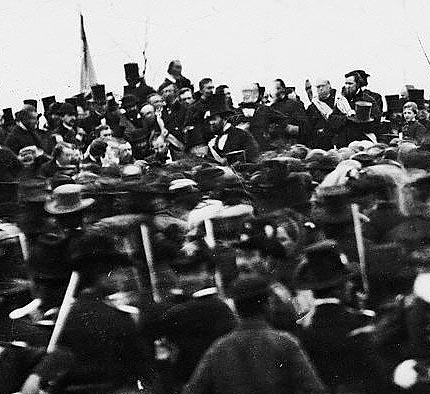
Some of the dead soldiers at Gettysburg.
President Lincoln on the stage at Gettysburg.

It may have gone unnoticed this week that we had an anniversary of an important event on the history of our cournty. Please take the time to read.

The Gettysburg Address
Abraham Lincoln
November 19, 1863
Four score and seven years ago our fathers brought forth on this continent a new nation, conceived in liberty and dedicated to the proposition that all men are created equal. Now we are engaged in a great civil war, testing whether that nation or any nation so conceived and so dedicated can long endure. We are met on a great battlefield of that war. We have come to dedicate a portion of that field as a final resting-place for those who here gave their lives that that nation might live. It is altogether fitting and proper that we should do this. But in a larger sense, we cannot dedicate, we cannot consecrate, we cannot hallow this ground. The brave men, living and dead who struggled here have consecrated it far above our poor power to add or detract. The world will little note nor long remember what we say here, but it can never forget what they did here. It is for us the living rather to be dedicated here to the unfinished work which they who fought here have thus far so nobly advanced. It is rather for us to be here dedicated to the great task remaining before us --that from these honored dead we take increased devotion to that cause for which they gave the last full measure of devotion-- that we here highly resolve that these dead shall not have died in vain, that this nation under God shall have a new birth of freedom, and that government of the people, by the people, for the people shall not perish from the earth.

Sunday, October 11, 2009

Modern Day Columbus Day

(This is the third of three postings having to do with Columbus Day. It might make more sense to read them in order written - third, second, first as posted on this blog.)

What is being taught in schools, now, about Columbus? How do the children celebrate the day? I remember coloring papers with a ship drawn on it. I remember being told how this brave man fought to convince the Queen to sponsor a voyage across the Atlantic. I remember being taught that Christopher Columbus discovered America. I was told that he almost had a mutiny because his crews thought they might fall off of the edge of the world, but he convinced them to go a little further.

What is being taught today:

In the kindergarten class taught by Jeff Kolowith in Tampa, Florida; the kids were told about how Columbus did not know where he was and that he was "very, very mean, very bossy."

Some schools no longer celebrate Columbus Day - Miami, Dallas, Los Angeles and Seattle.

According to a news story by AOL, "(M)any teachers are trying to present a more balanced perspective...and the suffering of indigenous populations."

According to James Dracht (Texas A&M College), you do not hear terms like "Columbus discovered America". Why? "Because how could he discover America if there were already people living here?"

I do not remember ever being taught that no one was here prior to Columbus or that he was the first human to touch American soil. No one ever said that or meant that and that is not what is meant by discovering America. I would expect that these same people who are rewriting our history have no trouble crediting Leif Ericson for the discovery of America (see next blog). Anything and anyone but what we have been taught. They have to tear down the man!

The AOL story, "In Texas, students start learning in the fifth grade about the 'Columbian Exchange' - which consisted not only of gold, crops and goods shipped back and forth across the Atlantic Ocean, but diseases carried by settlers that decimated native populations."

Let me see if I understand this teaching, correctly. The Europeans, mainly Columbus, schemed and carried out a plan to rape America of all of its goods in exchange for giving them diseases.

Again in the AOL story, a school in McDonald, PA had fourth-graders put Columbus on trial and charged him with "misrepresenting the Spanish crown and thievery." The ten-year-olds found him guilty and sentenced him to life in prison.

Let me see if I understand this correctly. A bunch of kids came up with this lesson plan all on their own without some teacher directing them in this attack on American history. These kids decided, without the mis-direction of the teacher, to charge Columbus with crimes.

A lady in Florida ran a survey of teachers to examine what materials were used to teach about Columbus. She concluded that many were "inaccurate - and sometimes outright demeaning - depictions of the native Taino population."

Let me see if I understand this correctly. Is it Columbus Day or Taino Day?

Again, from AOL - the same Kracht from Texas A&M, "The indigenous population was kind of waiting expectantly, almost with smiles on their faces. 'I wonder what his guy is bringing us?' Well, he's bringing us smallpox, for one thing, and none of us are going to live very long." He says that our multiculturalism has led more to study the cruelties suffered by the Taino people.

A New Jersey school forced some students to stand in a cafeteria and not be allowed to eat while others teased and intimidated the ones standing. This was so they would better understand the suffering that the people endured because of Columbus.

Remember, these are the same teachers who find reason to praise men like Castro.

Our history is being rewritten by the left-wing, radical, liberal wackos. Since these same people are now in control of much of the public education system in the America founded by Columbus, they are indoctrinating the next generation to be anti-America.

Leif Ericson

In observance of Columbus Day, it would not be complete without full disclosure.

For centuries we were told that Columbus was the first to discover America. Recently, we keep hearing how we should not celebrate Columbus Day or the man because he was not the first. So, what changed?

In 1960, archaeologists discovered the ruins of a settlement in L'Anse aux Meadows. This is located on the north tip of the large island of Newfoundland, off of eastern Canada. The artifacts found at the site were similar to those used by the Norsemen and consistent with the period of around 1000 AD. Evidence suggests that the people were not there very long before abandoning the settlement.

The Norsemen, or Norse (meaning people from the North), were first from the area of Scandinavia in Northern Europe. The are credited with establishing settlements in Iceland and Greenland. The term "Vikings" refers to the same group of people.

There are some Norse-Icelandic sagas that describe the exploration and attempted settlement, to the west, of a colony in 1003 AD. Evidently, this was led by a man named Leif Ericson. In the saga, the settlement was named Vinland.

It is not certain that Vinland is the same settlement found in Newfoundland or that Leif Ericson was the leader who established that settlement, but that appears to be the story that has gained widespread acceptance.

The main point that people use this to make is that someone was here (the Americas) pre-Columbian (besides the natives).

So, even if this is all true, and it appears that it is, why is this used as a reason to discredit Columbus? Why put him down because someone got to northeast Canada 500 years prior? When they got there, they did not do much and then left. Whatever they found and learned, it was mostly forgotten.

So, we can admit, even though Columbus was not the "very first" European to set foot on any area of the Americas, he was the one who made a difference. He was the one who started something that changed the rest of history. He was the one who made Europe aware of these new continents. So, if not technically correct; it is practically correct, he is the discoverer of America.

Columbus

"In 1492, Columbus sailed the ocean blue..."

That is how the story and teaching of Columbus began when I was in school.

The following is a map Columbus drew in 1490.

Christopher Columbus (1451 - 1506), was born in Italy, was a Roman Catholic. His occupation of maritime explorer for the Crown of Castile evolved after several short voyages around Europe.
He tried for years to convince various monarchs that he could establish a trade route with The Indies (southeast Asia) and have direct access to the spice trade. After being turned down, several times, finally King Ferdinand helped convince Queen Isabella of Spain that they should help sponsor the voyage. Columbus entered a contract with them as to what he would get if he found any new islands, etc. One of Columbus' sons later wrote that they agreed because they really did not believe he would make it back.
He left Europe on August 3, 1492 with three ships (Nina, Pinta, Santa Maria) and sailed to the Canary Islands where he restocked, leaving there on September 6, 1492. Around five weeks later, land was first spotted on October 12, 1492; which by coincidence happens to be the same date we set aside as "Columbus Day". Although he believed that he had reached the Indies (and named the people based on that), he was in the Caribbean. He was in the area until leaving to return with only the two smallest of the ships, after the Santa Maria had run aground. He left some men to establish a settlement in what is now Haiti. He took some natives back with him, though most died before getting to Europe. He arrived back to Europe on March 3, 1493.
He was to make three more voyages across the Atlantic (1493, 1498 and 1502). Spain and Portugal backed out of the contract with Columbus and actually had him arrested for awhile in 1500. After his death, some family kept the issue in court for many years. He never reached North America but visited several islands in the Caribbean and one time made it to Central America.
As to the story of him being one of the first to think the Earth was round, well, that does not appear to be true. There is historical evidence of others believing that for centuries prior to Columbus. What he did think is that the circumference of the Earth was smaller than others believed and he thought he could sail west from Europe to Asia while others believed it was too far. He was wrong and they were right, but his error resulted in the discovery of America.

Friday, September 11, 2009

War Supplement - 9/12/1944

Headlines and stories from this date: Sunbery Daily Item newspaper

Two-Way Invasion of Germany Near as Yanks Outflank Siegfried Line and Reds Attack Border Fortress

Air war gains in scope; Nazi losses mount

Allied attack on Philippines enters 3rd day

Nazis preparing Argentina bases for war

FDR and Churchill, meeting in Quebec, plan unified Pacific action

and; "Audacity Marks Historic Yank Invasion of Germany" This article tells about the first U.S. armed forces now being within the German border and how, on this day, U.S. tanks rolled across the border.

There is an ad for a new movie coming out - "Two Girls and a Sailor" with Gracie Allen, Jimmy Durante, Van Johnson and June Allyson.

On an inside page is a heading: "Polio eases off, no cases since Friday" This is a Tuesday.


San Francisco Chronicle newspaper has the following headlines:

Mighty U.S. Carrier Fleet Batters Philippines; 52 Jap Ships Sunk; Yanks Five Miles Into Germany!

The front page has the famous photo of a B-26, over France, that shows one engine being blown off by flak and the engine falling away from the plane.

Page 2 - Seven Die for Second Plot Against Hitler. Seven more were tried and hung, following the earlier execution of several others, for the failed attempt to assassinate Hitler.

There is a chart for the mileage to Berlin from each of the war fronts. (For some reason, it appears that Berlin was the center of attention.)

WWII Cursade Against Pinups

LIFE Magazine - September 11, 1944:

The cover photo is of hundreds of German soldiers being marched after being captured. The Allies have captured over 200,000 German prisoners in France, so far.

The magazine reprints three pages from a weekly newsletter done by Major Roy D. Craft, in France. Major Craft is on a crusade against other publications having pinup art on their pages. He writes these three newsletters to explain his position and demonstrate exactly what he is talking about:


There is an article with several photos about Paris being free.

9/11 We will NEVER forget...

Flag recovered at Ground Zero, NYC
Raising the USA flag at Ground Zero
The American Flag on the Pentagon


The Pentagon


U. S. A. U. S. A. U. S. A. U. S. A. U. S. A.

Today in History


Today - 9/11 - will always be remembered in our history. Eight years ago, the unexpected and unbelievable events will be forever etched in our memories. That day gives this generation a glimpse into what the last generation experienced with 12/7/1941. You will probably never forget where you were and how you first heard of the attack. If you were able to watch the events unfold, live on TV, which I imagine applies to most of us, you may have felt a helpless feeling of shock and disbelief. As it became evident that this was no accident but that the U.S. was under attack, some of those emotions may have transitioned into anger.

While we were sitting there watching and listening to the news as one thing after another took place, you had to wonder; who, how much more, how close to where we are, how many died, what do we do?

For some reason, the last generation's "Remember Pearl Harbor" determination, has not resulted in the same reverence for this event in this generation. We have those in our own country who think we need to move on, to focus on positive things, to make this a day of service, etc. Our media, for the most part, refuses to replay the scenes as a way of a memorial.

It is now PC to not talk about 9/11, unless you are discussing it from a pro-Muslim perspective. How can we be more sensitive to the feelings of the innocent Muslims within our borders and make them feel more comfortable.

Well, from my perspective, it is not about them! My thoughts, on this day, are not about sympathy for Muslims. If you want sympathy, direct it toward the families who lost loved ones in NYC, PA, and DC. Be thankful that we have not suffered similar attacks on our soil since that day. Appreciate the military for fighting the enemy on our behalf.

I do not need the media to show the images, I recorded them myself. I will never forget the horror of that day. I cannot imagine being in or at the Twin Towers as they evaporated and the utter fear that gripped them to their core. I can only hope that I would have helped in the sky over PA, at the same time knowing that this would be my last task. I cannot imagine what was in the minds at the Pentagon as, all of a sudden, part of the building exploded into a ball of fire and flames and fumes raced down the hallways. Or, as the Capital and White House were evacuated, what they were thinking as they ran and ran to get away.

From a future position, I remember Pearl Harbor and I will always remember 9/11. God bless them and their families on this day of remembrance and every other day.
NEVER FORGET!

War Supplement - 9/11/1944

U.S. troops reach German border at Trier.

Newspaper Headlines:
Allies Free Luxembourg, Enter Holland
Churchill and FDR meet in Quebec - "Victory is everywhere." Churchill said as he and the President shook hands.
1,000 U.S. Bombers Hit Nazi Industrial Targets
Yanks Blast Japs 5th Day in Row
Est Prussia Forts Smashed by Russians
Fifth Reaches Gothic Line Near Florence
French Reach Dijon Suburbs
Shelling of Aachen Reported - Nazi city declared under heavy fire.
Allies Gain Steadily on Siegfried Line - Nazis Pushed Back into The Wall - Nazi casualties reach 700,000.

Tuesday, September 8, 2009

War Supplement - 9/9/1944

Dewey (R), in his campaign for President, told a crowd that the US can no longer isolate herself from the rest of the World. He proposed the establishment of a world organization in which all nations may share as sovereign equals, to deal with future threats to the peace.

Allies trap 250,000 German soldiers in southeast Europe (Greece and Yugoslavia). The Belgium city of Liege has been taken and the U.S. First Army pushed to within 18 miles of Germany.

The Russians swarmed into Bulgaria and take Varna. Armies crossed the Danube River.

Yanks control the sky in South Philippines.

Sunday, September 6, 2009

War Supplement - 8/14 through 9/8/1944

1944-
8/14 - David Foil arrives in England.
8/15 - Operation Dragoon begins (Allied invasion of Southern France). Hitler states that this is the worst day of his life.
8/16 - German army begins a withdrawal from Southern France.
8/18 - Allieds fly 3,057 sorties against Falaise pocket in Southern France.
8/19 - French Resistance starts uprising in Paris.
8/20 - deGaulle returns to France.
8/25 - Paris is liberated. deGaulle retuns to Paris.
8/26 - Allied troops cross Seine and move east.
8/27 - RAF and more than 1,000 U.S. B-17s and B-24s attack in the first large-scale, daylight action over Germany.

9/1 - Patten takes Verdun.
9/3 - Brussels is liberated. National day of prayer is called in Britain for the 5th anniversary of the outbreak of the war. So far, the British causalities are reported as: 242,995 killed; 80,603 missing; 311,500 wounded; 290,381 captured.
9/4 - Antwerp is liberated.
9/6 - Victory in the "Battle of London" is proclaimed as V1 rockets are no longer being fired from France.
9/8 - V2 rockets hit London and Paris from Holland.

War Supplement - 1943 thru August 13, 1944

Some of the events preceding Dad's arrival in Europe in August of 1944:

1943-
7/9,10 - Allies land in Sicily.
7/25,26 - Mussolini arrested - Italian government collapses.
9/8 - Surrender of Italy is announced. (Italians, not Germans surrendering to Allies)
9/9 - Allies land at Salerno and Taranto, Italy.
9/12 - Germans rescue Mussolini.
10/13 - Italy declares war on Germany.

1944-
1/6 - Russians advance to Poland.
1/22 - Allies land at Anzio.
1/27 - Leningrad relieved after 900 day siege.
3/4 - First major daylight raid on Berlin.
3/18 - British drop 3,000 tons of bombs on Hamburg, Germany.
5/25 - Germans withdraw from Anzio.
6/5 - Allies enter Rome.
6/6 - D-Day at Normandy, France.
6/13 - First German V1 rocket attack on Britain.
7/3 - Battle of Hedgerows in France.
7/18 - U.S. troops reach St. Lo, France.
7/20 - German attempt to assassinate Hitler fails.
7/24 - Soviet troops liberate first concentration camp at Majdanek.
7/25 - 2,500 USAAF aircraft drop 4,150 tons of bombs on German and American positions at St. Lo, which kill 601 Americans.
8/1 - U.S. Marines capture Tinian Island.
8/2 - Churchill announces that after seven weeks of non-stop V1 rocket attacks (when 5,340 rockets were launched), 4,735 have been killed; 14,000 injured; 17,000 homes destroyed.
8/4 - First British jet fighter was successfully used. Anne Frank and her family were arrested and sent to Auschwitz. The purge of the German army was announced, following the attempt on Hitler's life.
8/6 - Last Jewish ghetto in Poland is closed with 60,000 Jews sent to Auschwitz.
8/7 - Germans begin major counter-attack in France.
8/10 - Japanese resistance ends on Guam.